
Refinancing an investment property is not the same process as refinancing your home. Lenders apply stricter credit standards, lower LTV limits, and more demanding documentation requirements. Without a clear investment property refinance checklist, investors routinely hit delays, get caught off guard by reserve requirements, or miss opportunities to lock better terms. This guide gives you a precise, step-by-step checklist covering pre-qualification criteria, documentation, loan product comparisons, and final closing steps so you can move through the refinance process with confidence and speed.
Table of Contents
- Key takeaways
- 1. Your investment property refinance checklist starts with pre-qualification criteria
- 2. Documentation checklist for investment property refinancing
- 3. Appraisal preparation
- 4. Comparing refinancing options and loan products
- 5. Final optimization steps before closing
- My take on investment property refinancing
- Refinance smarter with Investormultifamily
- FAQ
Key takeaways
| Point | Details |
|---|---|
| Stricter lender standards apply | Investment property refinances require higher credit scores, larger reserves, and lower LTVs than primary residence loans. |
| DSCR is a core qualifier | Lenders typically require a minimum DSCR of 1.25x, meaning your net operating income must exceed debt payments by 25%. |
| Documentation depth matters | Leases, rent rolls, Schedule E returns, and bank statements are all required to verify rental income accurately. |
| LTV limits cap your cash-out | Cash-out refinances on rental properties are generally capped at 75% LTV for single-family and 70% for 2-4 unit properties. |
| DSCR loans offer a faster path | Investors with complex tax returns can use DSCR loans to qualify on property cash flow rather than personal income. |
1. Your investment property refinance checklist starts with pre-qualification criteria
Before you submit a single document, you need to know whether your property and financial profile meet lender thresholds. Skipping this step is the most common reason refinances stall mid-process.
Credit score. Most conventional lenders require a minimum 680 credit score for investment property refinancing, with the best rates reserved for scores above 740. Even a 20-point difference can shift your rate by a meaningful margin on a six-figure loan.
Debt-to-income ratio. Your DTI must typically stay below 45%. Rental income can count toward your qualifying income, but lenders generally use only 75% of gross rent to account for vacancy and expenses.
Loan-to-value limits. For cash-out refinances, LTV caps on rentals are firm. Single-family rentals max out at 75% LTV and 2-4 unit properties at 70% LTV. On a $400,000 appraisal, that means your maximum new loan is roughly $280,000 to $300,000 before payoff and closing costs.
Seasoning requirements. Lenders typically require 6 to 12 months of ownership before approving a cash-out refinance. Properties purchased within six months generally do not qualify, and recent listings can reduce your maximum LTV.
Cash reserves. This is where many investors get surprised. Lenders require 6 to 12 months of mortgage payments in liquid reserves for investment properties, often more than what is required for a primary residence. If you own multiple financed properties, expect reserve requirements on each one.
DSCR. The debt service coverage ratio measures whether your property generates enough income to cover its debt payments. A minimum DSCR of 1.25x is the standard benchmark. If your NOI is $30,000 annually and your debt payments are $24,000, your DSCR is 1.25. Anything below that threshold will require a different loan structure.
Pro Tip: Run your DSCR calculation before you contact any lender. If you are below 1.25x, you can often improve it by extending your loan term, reducing your target loan amount, or increasing rents before applying.
2. Documentation checklist for investment property refinancing
Organized documentation is the difference between a 30-day close and a 90-day ordeal. Lenders need to verify your identity, income, assets, and property condition. Here is a categorized checklist.
Identity and income documents:
- Government-issued photo ID
- Two years of personal federal tax returns (including Schedule E for rental income)
- W-2s or 1099s for the past two years
- Recent pay stubs (if applicable)
- Business tax returns if you own a business entity
Rental income verification:
- Current signed lease agreements for all units
- Rent roll showing unit numbers, tenant names, lease terms, and monthly rents
- Twelve months of bank statements showing rent deposits
- Rental income documentation via Schedule E; lenders typically use 75% of gross rent for qualifying calculations
Asset and reserve documentation:
- Two to three months of bank and investment account statements
- Documentation of liquid reserves covering 6 to 12 months of PITI payments
- Retirement account statements if used to demonstrate reserves
Property-specific documents:
- Current mortgage statement showing outstanding balance and payment history
- Homeowner’s insurance declarations page
- Inspection and repair records, including before and after photos, itemized invoices, and closed permits
- HOA documents and payment history if applicable
Title and ownership:
- Title report confirming clear ownership
- Documentation of any liens or judgments and their payoff status
| Document category | Key items required | Common delay risk |
|---|---|---|
| Income verification | Tax returns, W-2s, Schedule E | Missing Schedule E or inconsistent figures |
| Rental income | Leases, rent rolls, bank statements | Undocumented rent deposits |
| Reserves | Bank and investment statements | Insufficient liquid assets |
| Property condition | Inspection records, permits, photos | Open permits or deferred maintenance |
| Title and liens | Title report, lien payoffs | Unresolved liens or ownership disputes |
Pro Tip: Create a dedicated folder, either digital or physical, for each property you plan to refinance. Pre-load it with all recurring documents like leases, insurance declarations, and tax returns so you can respond to lender requests within 24 hours instead of scrambling for days.
3. Appraisal preparation
The appraisal can make or break your refinance. A low appraisal reduces your loan amount, tightens your LTV, and can terminate the deal entirely. Preparation here is not optional.

Appraisers inspect property condition and review local comparable sales. The physical inspection typically takes 20 minutes to a few hours. What happens before the appraiser arrives determines a significant portion of the outcome.
Address deferred maintenance before scheduling the appraisal. Foundation cracks, HVAC issues, electrical problems, and open permits all signal risk to an appraiser and can suppress value. Closing out repair issues before the appraisal, including pulling and finalizing permits, removes red flags from the inspection report.
Research your own comps. Pull recent sales within a half-mile radius of similar size, age, and condition. If you believe the appraiser missed a strong comparable, you have the right to submit a reconsideration of value with supporting data. This process is underused and often effective.
Preparing repair documentation with photos and receipts can positively influence the appraisal outcome by demonstrating the quality and scope of improvements made to the property.
4. Comparing refinancing options and loan products
Not all refinance products are built the same. Choosing the wrong loan type costs you money, time, or both. Here is how the main options compare.
Rate-and-term refinance. This replaces your existing mortgage with a new one at a different rate or term. No cash is extracted. LTV limits are more flexible, often up to 80%, and qualification is generally easier. This option works best when your goal is to reduce monthly payments or shorten your loan term.
Cash-out refinance. You refinance for more than you owe and receive the difference in cash. LTV limits are stricter at 75% for single-family and 70% for 2-4 unit properties. Investment property rates run 0.5% to 0.75% higher than primary residence rates, with cash-out refi rates in 2026 typically ranging from 6.75% to 7.5%. Closing costs add another 2% to 6% of the loan amount.
Conventional loans. These follow Fannie Mae and Freddie Mac guidelines. They require full income documentation, strong credit, and compliance with DTI limits. They offer competitive rates for investors who qualify but are slow to process and strict on documentation.
DSCR loans. DSCR loans qualify on property cash flow rather than personal income. No W-2s, no tax returns, no DTI calculation. Approval is based on whether the property generates enough rent to cover the debt. Closings happen in weeks rather than months. The tradeoff is slightly higher rates and prepayment penalties on many products.
| Feature | Conventional refi | DSCR loan |
|---|---|---|
| Income documentation | Full (W-2s, tax returns, DTI) | Property cash flow only |
| Credit score minimum | 680+ | 620-680+ depending on lender |
| LTV (cash-out) | Up to 75% | Up to 70-75% |
| Closing timeline | 30-60 days | 2-4 weeks |
| Prepayment penalty | Rarely | Common (3-5 year terms) |
| Best for | W-2 investors with clean docs | Self-employed, portfolio investors |
DSCR loans have become the go-to product for investors with complex tax structures or multiple properties. Rising DSCR minimum thresholds reflect lenders stress-testing income assumptions and incorporating lease rollover risks, which means underwriting is more rigorous than it was two years ago. Know your numbers before you apply.
5. Final optimization steps before closing
Once you have selected a loan product and submitted your application, there are still critical steps that determine your final outcome.
- Shop at least three lenders. Rate differences of 0.25% to 0.5% on a $300,000 loan translate to thousands of dollars over the loan term. Do not accept the first quote.
- Lock your rate strategically. Rate locks typically run 30 to 60 days. If your close date is uncertain, a longer lock period costs more but protects you from rate spikes.
- Recalculate post-refinance cash flow. Model your new monthly payment against your rental income before closing. A lower rate does not always mean better cash flow if closing costs reset your break-even timeline.
- Review the Loan Estimate carefully. Verify the interest rate, APR, monthly payment, prepayment penalty language, and all fees. Errors in loan estimates are more common than investors expect.
- Confirm title is clear. Do not assume the title search is complete until you receive written confirmation. Unresolved liens discovered at closing can delay or kill the deal.
- Prepare for post-closing monitoring. Set up automatic payments on the new loan immediately. Track your DSCR quarterly to stay ahead of any performance issues.
Pro Tip: If your DSCR is close to the lender minimum, consider capital stacking strategies such as extending the loan term or increasing the down payment to improve your ratio structurally before the application, rather than hoping the lender will make an exception.
My take on investment property refinancing
I have worked with enough investors to know that the ones who struggle most with refinancing are not the ones with the weakest properties. They are the ones who treat the process like a primary residence refi and get blindsided by the documentation depth and reserve requirements.
The biggest mistake I see is investors applying before they have run their own DSCR. They assume the property qualifies because it cash flows positively on paper. But lenders are now stress-testing those assumptions, incorporating environmental and lease rollover risks into underwriting. A property that felt comfortable six months ago may not clear the 1.25x threshold today.
My honest take on DSCR loans: they are not a workaround. They are a purpose-built product for investors whose financial complexity makes conventional documentation a poor reflection of their actual performance. If you own multiple properties and your Schedule E shows paper losses due to depreciation, a DSCR loan will give you a cleaner path to approval than fighting a conventional underwriter over adjustments.
On cash-out refinancing in a higher rate environment, the math still works if you deploy the capital into a deal that returns more than the cost of the debt. The investors who get into trouble are the ones who pull cash out without a clear deployment plan. Treat the refinance as a capital allocation decision, not just a paperwork exercise.
— Joe
Refinance smarter with Investormultifamily
Investormultifamily specializes in business-purpose financing built for real estate investors across New England and Florida. Whether you are pursuing a cash-out refinance on a rental or need a DSCR loan that qualifies on property income rather than personal tax returns, Investormultifamily has the products and speed to close that conventional lenders cannot match.
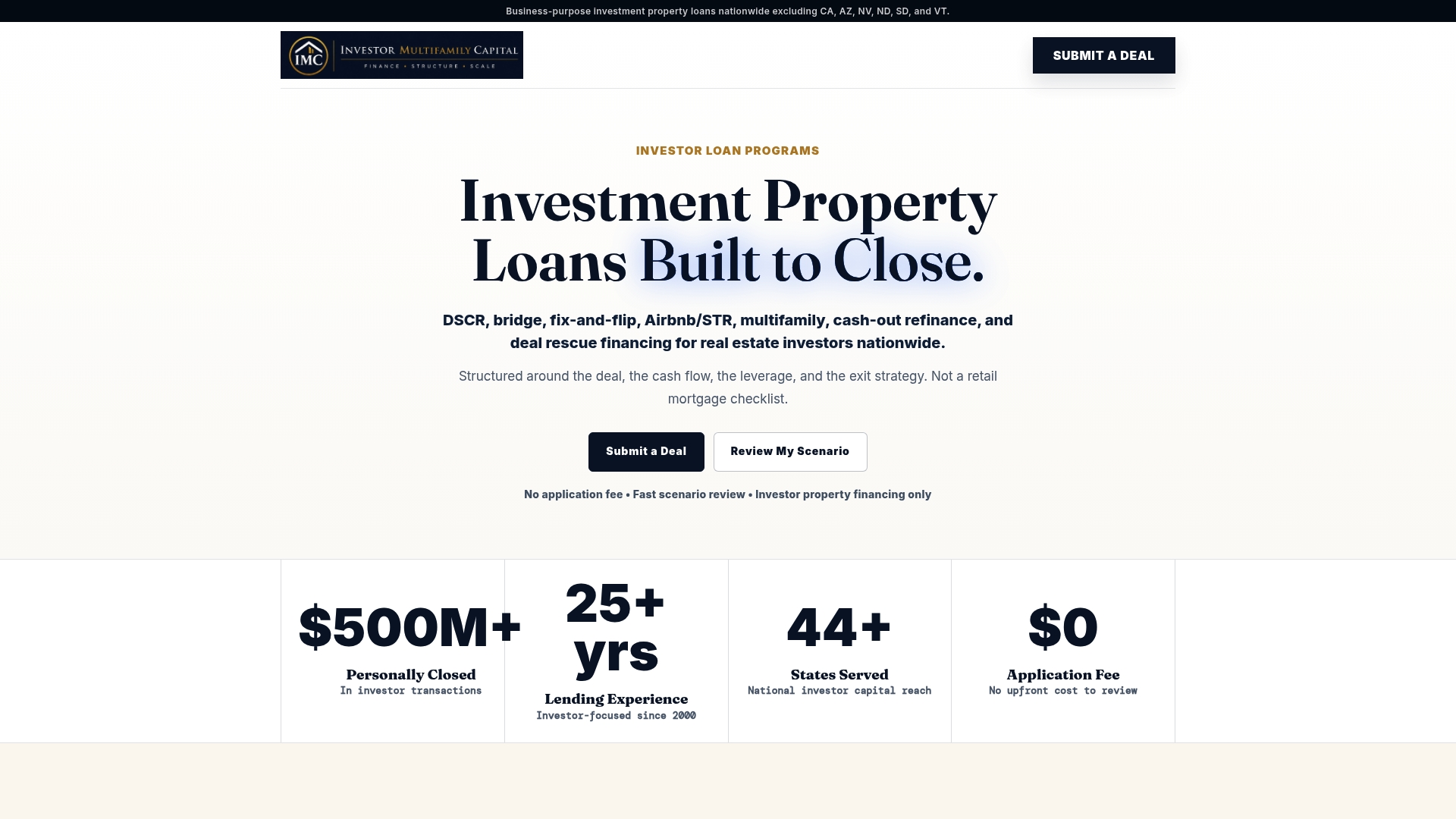
Investormultifamily offers DSCR loan programs for single-family rentals, multifamily properties, and short-term rentals across MA, NH, RI, CT, ME, and FL. Approvals are based on property cash flow. No W-2s required. No DTI calculations slowing you down. If you are ready to refinance an investment property or want to review your scenario before applying, contact Investormultifamily directly to get a fast, investor-focused assessment of your deal.
FAQ
What credit score do I need to refinance an investment property?
Most lenders require a minimum 680 credit score for investment property refinancing, with the best rates available above 740. Lower scores may still qualify with certain DSCR loan products depending on the lender.
How does DSCR affect my refinance eligibility?
A minimum DSCR of 1.25x is the standard lender benchmark, meaning your property’s net operating income must be at least 25% higher than its annual debt payments. Properties below this threshold may need restructuring before qualifying.
What is the maximum LTV for a cash-out refinance on a rental property?
The maximum LTV for a cash-out refinance is typically 75% for single-family rental properties and 70% for 2-4 unit multifamily properties. On a $400,000 appraisal, that limits your new loan to roughly $280,000 to $300,000 before costs.
How long do I need to own a property before refinancing?
Most lenders require 6 to 12 months of ownership seasoning before approving a cash-out refinance on an investment property. Properties owned for less than six months generally do not qualify for cash-out products.
What makes DSCR loans different from conventional investment property loans?
DSCR loans qualify based on property cash flow rather than personal income, eliminating the need for W-2s, tax returns, or DTI calculations. They close faster than conventional loans but typically carry higher rates and prepayment penalties.