
TL;DR:
- Building a property portfolio involves acquiring multiple investment properties to generate rental income and appreciate in value through diversification across types and locations. Effective portfolio management depends on disciplined cash flow analysis, leveraging equity through refinancing, and implementing systems for tracking performance and planning exits. Proper diversification, strategic financing, and ongoing performance review are essential for long-term portfolio resilience and growth.
A property portfolio is defined as a collection of investment properties owned to generate rental income and long-term capital appreciation, with diversification across property types and locations as the primary method for reducing risk. Building a real estate portfolio is not a single transaction. It is a systematic process of acquiring, financing, and managing multiple assets to create reliable income streams and compounding equity growth. This guide covers building property portfolio explained from the ground up: cash flow calculation, equity recycling, diversification strategy, and portfolio management systems that serious investors use to scale without overextending.
What does building a property portfolio actually mean?
Building a property portfolio means assembling multiple real estate assets with a defined purpose, whether that is recurring cash flow, capital growth, or both. Each property in the portfolio serves a role, and the collection as a whole performs better than any single asset could alone. The industry term for this practice is real estate portfolio management, and it applies whether you own two rentals or twenty.

The core benefits are three: recurring income streams from rent, equity growth as property values rise, and scalability through reinvestment. Diversification across property types and locations protects against vacancies in any single market and enables equity recycling to fund new acquisitions. Without a clear purpose and structure from the start, most investors end up with a collection of properties rather than a functioning portfolio.
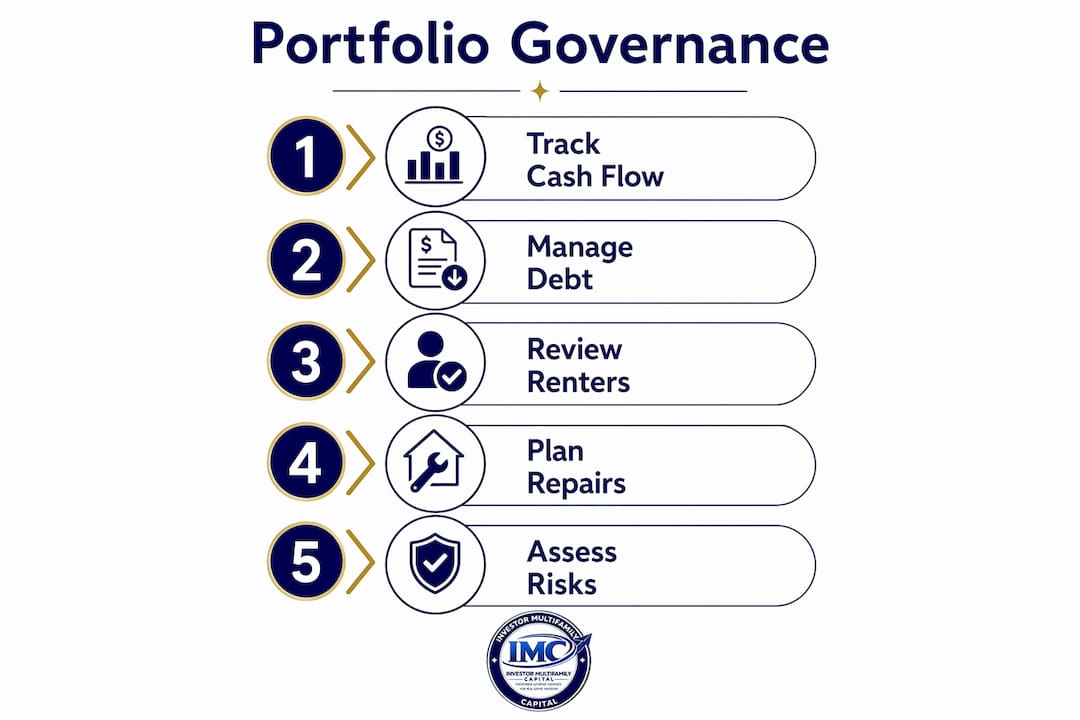
Portfolio governance is the framework that keeps everything running. It includes how you track cash flow, manage debt, review performance, and plan exits. Investors who treat their portfolio as a business from day one scale faster and with fewer costly mistakes.
How do you calculate true cash flow on a rental property?
True cash flow is monthly rent minus every expense, including mortgage interest, property taxes, insurance, management fees, repairs, and a vacancy allowance. Headline yield figures from listing platforms ignore most of these costs. Relying on gross yield alone is one of the most common errors new investors make.
Here is a practical example. A property renting for $2,400 per month looks attractive on paper. Run the full numbers:
- Mortgage payment: $1,200
- Property taxes (monthly): $250
- Insurance: $100
- Property management (10%): $240
- Repairs and maintenance reserve: $150
- Vacancy allowance (5%): $120
Total monthly expenses: $2,060. True cash flow: $340 per month. That is a very different picture from the gross rent figure. True cash flow calculation is the only reliable way to evaluate whether a property is cash-flow positive or negative.
Cash flow survival is the real test. Your portfolio must generate enough net income to absorb rent gaps, emergency repairs, and rising insurance costs without requiring capital injections from your personal income. Tracking key rental metrics like net operating income (NOI) and debt service coverage ratio (DSCR) gives you a clear read on each property’s health.
Pro Tip: Some experienced investors deliberately accept initial negative cash flow on a high-growth asset, provided the shortfall is affordable and the equity upside is well-documented. The key word is “deliberate.” Negative cash flow by accident is a liability. Negative cash flow by design, with a clear timeline to positive territory, is a strategy.
How does equity recycling scale a property portfolio?
Equity recycling is the mechanism that allows investors to grow a portfolio without injecting fresh capital at every step. Once a property appreciates in value, you refinance to access the built-up equity and use those funds as a down payment on the next acquisition. Equity recycling typically begins after 2–4 years, depending on market conditions and repayment progress.
This compounding effect is what separates investors who own two properties from those who own ten. Each refinance funds the next purchase, which then builds equity, which funds the next refinance. The cycle repeats without requiring large cash reserves at each stage.
Key financing considerations for portfolio scaling include:
- Loan-to-value (LTV) ratios: Lenders assess the portfolio as a whole as it grows. Maintaining healthy LTV ratios across all properties protects future borrowing capacity.
- DSCR loans: DSCR financing qualifies based on property cash flow, not personal income. This is the preferred structure for investors scaling beyond two or three properties.
- BRRRR strategy: Buy, Rehab, Rent, Refinance, Repeat is a structured version of equity recycling applied to value-add properties. BRRRR financing accelerates portfolio growth by recycling capital through forced appreciation.
- Cash-out refinancing: Pulling equity from stabilized assets funds new acquisitions without selling existing holdings.
Portfolio growth financed through refinancing requires lenders to see healthy LTV ratios across all assets. Stress test every refinance scenario against a higher interest rate environment before executing. Leverage amplifies gains and losses equally.
Pro Tip: Disciplined financing means never refinancing to the maximum available equity. Leave a buffer in every property. That buffer is your protection when a market softens or a major repair hits.
What diversification strategies reduce portfolio risk?
Over-concentrated portfolios underperform when market conditions shift. An investor who owns six single-family rentals in one city is exposed to that city’s job market, rental demand, and regulatory environment all at once. Intentional diversification is the fix.
Effective diversification operates across four dimensions:
| Diversification Category | Risk Benefit |
|---|---|
| Geographic spread (multiple markets) | Reduces exposure to single-market downturns or local regulation changes |
| Property type mix (residential, multifamily, commercial) | Balances income stability with growth potential across asset classes |
| Price point variation | Protects against demand shifts at any single price tier |
| Tenant and industry mix | Prevents revenue concentration in one employer or sector |
Most investors start with geographic and property type diversification. The more advanced move is diversifying based on economic drivers. Properties diversified by employment base and tenant industry behave differently under stress than properties that appear geographically diverse but share the same underlying economic exposure. Two properties in different cities but both dependent on the same regional employer are not truly diversified.
For investors holding commercial or multifamily assets, lease structure is a critical diversification tool. Staggering lease expiration dates prevents synchronized vacancies that create income gaps across the entire portfolio at once. A portfolio where every lease expires in the same quarter is a cash flow risk, regardless of how many properties it contains. Spreading lease rollover dates across the calendar year smooths income and reduces volatility.
Balancing rental yield versus capital growth across property types also matters. High-yield assets generate immediate cash flow. High-growth assets build equity faster. A well-constructed portfolio holds both.
What systems does effective portfolio management require?
Treating a portfolio like a business is the single most important operational shift an investor can make. A business has systems. A collection of properties does not.
The core systems every portfolio needs as it scales:
- Rent tracking: A centralized ledger showing rent collected, arrears, and payment history across all properties. Tools like AppFolio or Buildium handle this at scale.
- Maintenance scheduling: Preventive maintenance calendars reduce emergency repair costs. Track every HVAC service, roof inspection, and plumbing check.
- Compliance monitoring: Local landlord-tenant laws, safety certifications, and licensing requirements vary by state and municipality. Non-compliance creates liability.
- Tenant communication logs: Document every interaction. This protects you legally and creates a clear record for property managers.
- Monthly financial review: Review NOI, DSCR, and cash-on-cash return for each property every month. Identify underperformers before they become problems.
Portfolio governance becomes critical as scale increases. At two properties, you can manage informally. At eight, informal management creates gaps that cost money. Build the systems before you need them.
Exit strategy planning belongs in the portfolio management conversation from day one. Know the exit for every asset before you buy it: hold and refinance, sell and 1031 exchange, or convert to a different use. Investors who plan exits in advance make better acquisition decisions and avoid being forced into bad sales by circumstance.
Pro Tip: The most common portfolio management failure is not tracking vacancy costs accurately. Investors record lost rent but forget to count turnover costs: cleaning, repairs, re-leasing fees, and the time between tenants. Add all of it to your vacancy calculation.
Key takeaways
Building a property portfolio requires disciplined cash flow analysis, equity recycling, intentional diversification, and business-grade management systems working together from the first acquisition.
| Point | Details |
|---|---|
| Calculate true cash flow | Subtract all expenses from rent, not just the mortgage, to assess real profitability. |
| Use equity recycling to scale | Refinance appreciated assets every 2–4 years to fund new acquisitions without fresh capital. |
| Diversify across economic drivers | Spread properties by location, type, tenant industry, and lease rollover dates. |
| Build management systems early | Implement rent tracking, compliance, and financial review before the portfolio grows large. |
| Plan exits from the start | Define the exit strategy for each asset at acquisition to guide long-term portfolio decisions. |
What i’ve learned building portfolios that actually last
Most aspiring investors focus almost entirely on acquisition. They spend months analyzing markets, running numbers on deals, and securing financing. Then they buy the property and stop thinking systematically. That is where most portfolios stall.
The investors I have seen build genuinely resilient portfolios share one habit: they review performance data monthly and act on it. Not annually. Not when something breaks. Monthly. They know their DSCR on every asset, their vacancy rate by quarter, and their total portfolio LTV at any given time. That discipline is what allows them to refinance at the right moment, spot an underperformer before it drags the whole portfolio, and make acquisition decisions based on real numbers rather than optimism.
The other thing I would push back on is the conventional wisdom that diversification means buying in different cities. Geographic spread helps, but two properties in different markets can still share the same risk profile if they depend on similar tenant industries or have synchronized lease expirations. True diversification requires thinking about what drives each property’s income, not just where it sits on a map.
Finally, leverage is not the enemy. Undisciplined leverage is. Equity recycling through DSCR loans and cash-out refinancing is how serious investors scale without waiting decades to save fresh down payments. The discipline is in the buffer: never pull every dollar of available equity, always stress test at higher rates, and always know your exit before you execute the refinance.
— Joe
Financing built for portfolio growth
Scaling a property portfolio requires financing that moves at investor speed and qualifies on property performance, not W-2 income. Investor MultiFamily Capital provides business-purpose loans across New England and Florida, including DSCR loans, BRRRR financing, multifamily loans, and cash-out refinancing, all structured for investors building and scaling real estate portfolios.

Whether you are recycling equity from an existing asset or financing your next multifamily acquisition, Investor MultiFamily Capital underwrites on cash flow. Investors in Massachusetts, Connecticut, New Hampshire, Maine, Rhode Island, and Florida can explore multifamily financing options or review investment property loan options built for portfolio-scale deals. Submit a Deal or Run Deal Analysis to get started.
FAQ
What is a property portfolio in real estate?
A property portfolio is a collection of investment properties owned to generate rental income and capital appreciation. Diversification across property types and locations is the standard method for reducing concentration risk.
How do i start building a real estate portfolio?
Start with a clear purpose, either cash flow, capital growth, or both, then acquire your first property using financing that qualifies on rental income. Use equity recycling after 2–4 years to fund subsequent acquisitions without fresh capital.
What is equity recycling in property investing?
Equity recycling is the process of refinancing an appreciated property to access built-up equity and using those funds as a down payment on the next acquisition. This compounds portfolio growth without requiring large cash reserves at each step.
What is a DSCR loan and why does it matter for portfolio investors?
A DSCR loan qualifies based on the property’s debt service coverage ratio, meaning the rental income relative to the loan payment, rather than the borrower’s personal income. This structure is ideal for investors scaling beyond a few properties.
How many properties do you need for a diversified portfolio?
There is no fixed number, but meaningful diversification typically requires at least 3–5 properties spread across different locations, property types, or tenant profiles. The goal is to ensure no single vacancy or market shift can significantly disrupt total portfolio income.
Investor-only. Business-purpose investment property financing only. Not for owner-occupied or primary residence loans.
Recommended
- What Is a Real Estate Portfolio? Your 2026 Investor Guide | Investor MultiFamily Capital
- Investment Property Loans Built to Close | Investor MultiFamily Capital
- Leverage Explained for Property Investing: 2026 Guide | Investor MultiFamily Capital
- Rental Portfolio Financing | Investor MultiFamily Capital